- ForgeHub
- Posts
- What Replaced Commando Comics?
What Replaced Commando Comics?

Richard Morrissey
March 17, 2026
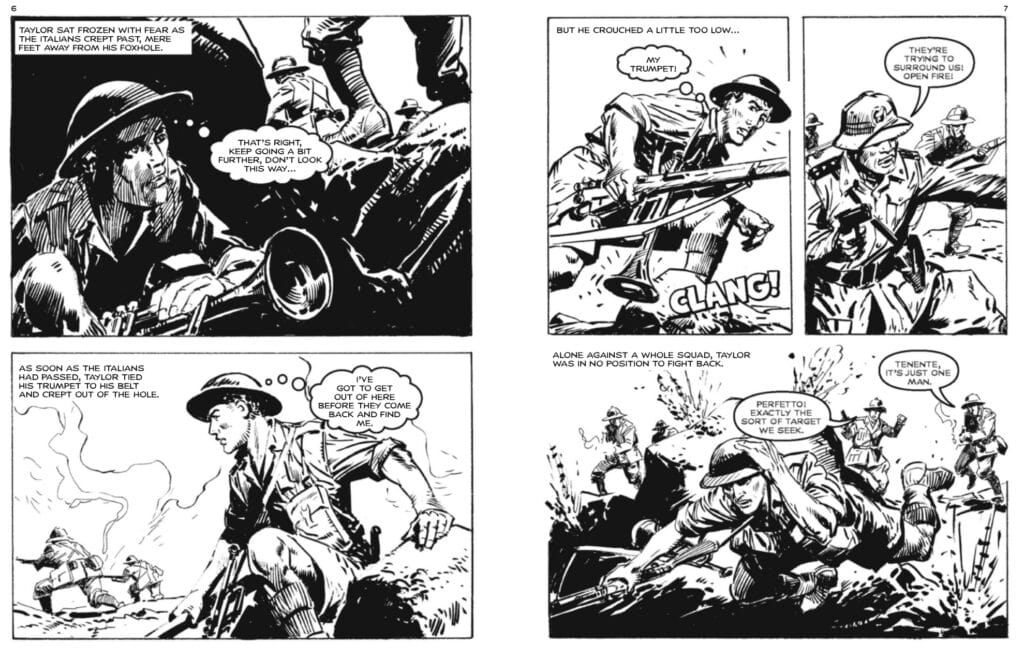
A generation of British boys grew up fluent in a language that existed nowhere else. Schnell. Gott im Himmel. Banzai! You did not need to have studied German or Japanese to know that the man shouting it was about to have a very bad day. Four times a month, for the price of a few pence, a pocket-sized comic arrived on every newsstand in Britain and a boy could re-fight the Second World War before his tea.
Commando launched in July 1961 and is still in print today. At its peak it was selling millions of copies annually. It was not sophisticated. The artwork was black and white, the plots were formulaic, and the Germans and Japanese (the Japs) rarely said anything other than those stock phrases. But alongside Victor, Warlord and Battle Picture Weekly, it was a shared imaginative world. Every boy in your class had read the same stories. Every boy knew what it looked like when a man held his nerve, when a coward proved himself, when enemies fighting side by side in a shell crater stopped being enemies. You absorbed a moral vocabulary before you were old enough to name it.
That vocabulary had content. The characteristic motifs of Commando were courage, cowardice, patriotism, dying for one's country, and enmity turning into friendship when the going got tough. These were not incidental to the stories. They were the stories. And the sacrifice in them was never abstract. It was always for the men beside you, the civilians in the village you were holding, the crew of the aircraft you were bringing home. Duty was made personal, which is the only way it ever lands. A man who failed under fire had to find a way back to himself. A man who hated his enemy came to understand him. Moral complexity was built into the formula at the price of a child's pocket money. This was formation by narrative, handed to an entire generation of boys simultaneously, free with the price of a comic.
The formation was unofficial and nobody called it that. It happened because boys wanted stories about men doing hard things, and the market provided them cheaply and in enormous quantities.
George Orwell wrote about boys' weeklies in 1940 and was struck by something most of his contemporaries considered too trivial to notice. These penny comics, he argued, were doing serious moral and political work. They presented a world of stable categories: courage rewarded, cowardice exposed, loyalty tested and vindicated. Boys absorbed those categories as naturally as they absorbed grammar. Orwell was ambivalent about the politics embedded in that stability. But his observation holds true, and applies to Commando as squarely as it applied to the Gem and the Magnet: popular stories for boys have always been doing formation work, whether or not anyone in authority was paying attention. The question he did not have to ask, because it had no answer in 1940, is what happens when the shared story disappears entirely and every boy is left to assemble his own from whatever the feed provides.
That world did not end overnight. The weeklies gave way to other forms of shared story: the moral complexity of Judge Dredd, the anti-hero of The Professionals on television, eventually the superhero blockbuster in the cinema. The fragmentation was gradual. First the specialist shop replaced the newsagent, then the living room TV screen replaced the shared playground conversation. What finally broke the thread entirely was not a single cultural shift but a technology: the algorithm, which replaced the shared newsstand with a personalised feed and made it impossible for boys to inherit a common world at all.
The boy who once passively absorbed the same stories as every boy on his street now actively generates a bespoke world by clicking. The algorithm does not give him a culture. It gives him a mirror, reflecting and then amplifying his deepest insecurities back at him until they feel like truths. One boy gets gym content. Another gets political rage. The angry, isolated boy gets Andrew Tate, delivered in a weird disembodied Anglo-American accent through a single earbud, a private sermon for an audience of one.
Tate is not a cause. He is a replacement. In the absence of a thick, common narrative about what men are for, boys go looking for a ready-made script. Tate's script is available, relentless, and free at the point of use. It offers status, money, dominance and the intoxicating suggestion that the world owes you something it has been withholding. The sacrifice in his stories is never for the men beside you. It is always for yourself. That is not a small difference. It is the difference between formation and performance: one shapes a self to take into the world, the other builds a mask for the algorithm.
Commando's version of manhood was imperfect. The Germans saying schnell were a narrative convenience rather than people, the patriotism sometimes naive, the heroism sometimes unrealistic. But the story left room for the enemy to become human. Tate's world does not. Commando was embedded in a national story, oriented toward something beyond the individual, built on the premise that being a man involves obligation as well as strength. Tate's version is its mirror image: individualist, monetised, built entirely around personal power and the humiliation of weakness. One cost fourpence. The other costs a subscription and, eventually, something harder to get back.
You cannot hand a sixteen-year-old a pile of Commando comics and recreate 1973. The shared culture that made those stories work is gone and will not return. But the need those stories met has not gone anywhere. Boys still want to know what a man is. They still want models of courage, loyalty and restraint. They still want to be told that becoming a man is an achievement worth the effort.
If you are reading this, someone probably gave you those things, imperfectly and informally, through stories and examples and the presence of men who had standards. The question is whether there is a younger man in your life who is getting his answer from an algorithm. And if there is, what story are you offering him instead? Not a lecture. Not a programme. A story. Your own, told honestly, about a time you held your nerve or failed to, about what loyalty cost you, about what you are still learning. Tate found the boys nobody was talking to. Go and find them first.
ForgeHub (theforge-hub.com) serves as my writing platform for men seeking practical wisdom, developing authentic skills, and reflecting on how to live purposefully in a complex world. I write about family formation and cultural analysis at Happy Family Better World. My new family advisory site is at richardmorrissey.org. My political writing can be found at Medium.
Reply